

Updated March 2026
The Testa di Moro, or Moor’s Head, is one of the most recognisable symbols of Sicily. These hand-painted ceramic vases peer out from balconies all over the island, vivid and striking. But behind their beauty lies a legend of passion, betrayal, and revenge that has echoed through Sicilian culture for nearly a thousand years.
Whether you are visiting Sicily for the first time or you grew up with a pair of Teste di Moro on your grandmother’s balcony, there is more to this symbol than meets the eye.
What Is a Testa di Moro?
A Testa di Moro (plural: Teste di Moro) is a hand-painted ceramic vase in the shape of a human head. In Sicilian dialect, they are also called graste. Traditionally they come in pairs: a male head wearing a turban, richly decorated with jewels, fruit, and flowers, alongside a female head wearing a crown. Both are usually overflowing with plants, most traditionally basil.
🏺 Did you know? The Sicilian city of Caltagirone is considered the home of the Testa di Moro. Its master potters have been producing handmade ceramics for centuries, and the Teste di Moro from Caltagirone are prized above all others.
The Legend Behind the Moor’s Head
The story goes back to the 11th century, during the Arab domination of Sicily, which lasted from 827 to 1091. There are two main versions of the legend, and both are worth knowing.
Version 1: The Girl of the Kalsa
We are in Palermo, in the district known as the Kalsa, the Arab quarter of the city. A beautiful Sicilian girl lived there, and she spent her days tending to the plants on her balcony. One day, a Moor passing through the street looked up, saw her, and fell completely in love. He declared his feelings, she returned them, and a love story began.
But the Moor had a secret. He would soon return to the East, where a wife and children were waiting for him. When the girl discovered the truth, she was consumed by jealousy and wounded pride. One night, while he slept, she killed him and cut off his head. She placed his head on her balcony and used it as a vase, planting a sprig of basil inside. She watered it with her tears.
The basil grew more lush and vibrant than anything the neighbours had ever seen. Curious and envious, they began asking local craftsmen to make terracotta vases in the shape of a Moor’s head. And so the tradition was born.
🌿 A note on basil: Basil was known in the ancient world as the “herb of kings.” Its connection to the Moor’s Head legend is no accident. In Southern Italian and Sicilian folklore, basil has long been associated with love, death, and remembrance.
Version 2: The Noble Girl and the Forbidden Love
The second version is less dramatic but perhaps more historically grounded. In this telling, a young Sicilian woman of noble origins falls into a clandestine relationship with a young Arab man. When their love is discovered, both are beheaded. Their heads are placed on a balcony as a public warning, a symbol of shame and forbidden love.
This version also explains something the first does not: why the Teste di Moro almost always come in pairs. One head for the man, one for the woman. Two lives, one story.
📖 A literary echo: This second version closely mirrors a tale from Boccaccio’s Decameron (Day 4, Tale 5), in which a woman named Lisabetta hides the severed head of her murdered lover Lorenzo in a pot of basil. Whether Boccaccio inspired the Sicilian legend or drew from it remains debated.
The History of Sicilian Ceramic Moor’s Heads
The legend may be rooted in the 11th century, but the earliest ceramic Teste di Moro scholars can trace date to the late 1700s. By the 19th century, they had become a fixture of Sicilian homes, balconies, and markets.
The craft of making them is deeply tied to the tradition of Sicilian ceramics, which has been handed down from master to apprentice for generations. Every piece is shaped and painted by hand. The richness of the decoration reflects the skill of the individual artisan: no two are exactly alike.
Today, the Testa di Moro has moved far beyond the island. It appears in international interior design, has inspired fashion collections, and even featured in the second season of HBO’s The White Lotus, filmed in Sicily, where the concierge explains the legend to arriving guests. Designers including Dolce & Gabbana have built entire collections around the image.
What Do the Moor’s Heads Represent?
At one level, the Testa di Moro is a piece of craft: beautiful, colourful, and unmistakably Sicilian. But it also carries layers of meaning that are worth sitting with.
🏛️ History
A living reminder of Sicily’s Arab period, one of the most culturally rich chapters in the island’s history.
❤️ Passion
A symbol of love in all its forms: desire, jealousy, loss, and the lengths people will go to hold onto what they love.
🎨 Craft
A testament to centuries of Sicilian ceramic artisanship, especially the tradition of Caltagirone.
🌍 Identity
One of the first things most people think of when they think of Sicily. A symbol recognised around the world.
Bring a Piece of the Legend Home
The Testa di Moro is not just a decorative object. It has made its way into Sicilian food culture too. One of the most beautiful expressions of this is the ‘Teste di Moro’ PGI Sicily Extra Virgin Olive Oil from Dolceterra: a cold-pressed, unfiltered Sicilian EVOO housed in a hand-decorated bottle shaped exactly like the iconic head.
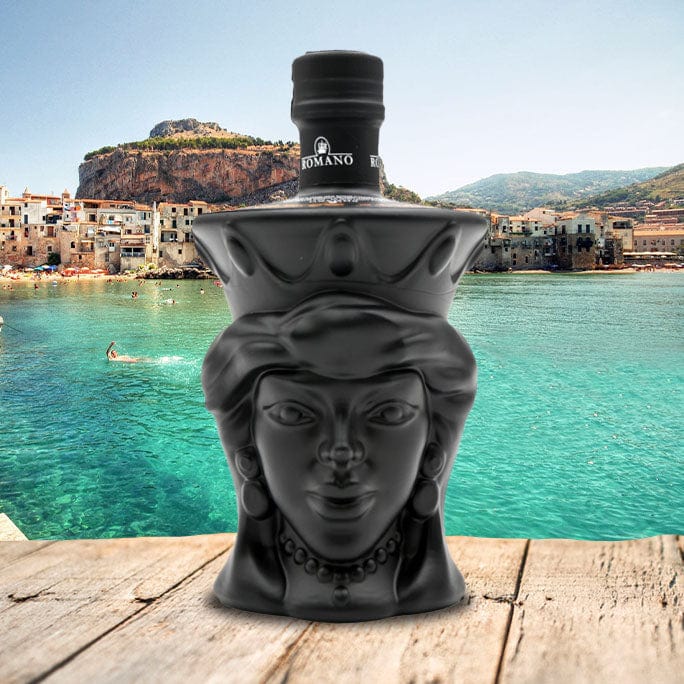
The oil itself is PGI-certified Sicilian extra virgin, with notes of artichoke, almond, and fresh tomato. It is the kind of bottle you display on the table rather than hide in a cupboard. And when the oil is finished, the bottle stays.
Shop the Teste di Moro Olive Oil on Dolceterra — they ship internationally, and it makes one of the most thoughtful Sicilian gifts you can give. And remember, you can get a 10% discount by using our code sicilianfooculture10
🫒 A gift with a story: If you are looking for something to give to a Sicilian food lover, this bottle is hard to beat. It carries the legend, the craft, and the flavour of Sicily in one object.
Frequently Asked Questions
What does Testa di Moro mean?
Testa di Moro is Italian for “Moor’s Head.” It refers to the traditional Sicilian ceramic vases shaped like human heads, associated with the legend of an Arab man and a Sicilian woman during the period of Arab rule in Sicily.
Why do Moor’s Heads always come in pairs?
According to the second version of the legend, both a young Sicilian woman and her Arab lover were beheaded when their relationship was discovered. Their heads were displayed together as a warning. This is why the Testa di Moro traditionally comes as a pair: one male, one female. Pairs are also considered a symbol of good luck.
Where can I find Testa di Moro products outside of Sicily?
For a unique take on the symbol, Dolceterra’s Teste di Moro PGI Olive Oil comes in a hand-decorated bottle shaped like the iconic head and ships internationally. For decorative ceramic pieces, Caltagirone in central Sicily is the home of the finest handmade Moor’s Heads.
Are the Moor’s Heads connected to the Sicilian flag?
The Moor’s Head (Testa di Moro) and the Trinacria on the Sicilian flag are separate symbols, but both reflect Sicily’s complex multicultural history. The head on the Sicilian flag is the head of Medusa at the centre of the Trinacria, not a Moor’s Head specifically.
What is the connection to Boccaccio’s Decameron?
The second version of the Moor’s Head legend closely mirrors Tale 5 of Day 4 in Boccaccio’s Decameron, in which a woman named Lisabetta hides the head of her murdered lover in a basil plant. Whether Boccaccio drew from Sicilian folklore or the legend was influenced by Boccaccio is still debated by scholars.
Keep Exploring Sicilian Culture
🏳️ The History of the Sicilian Flag
The Trinacria, the three-legged symbol, and what it really means.
👑 Are You a Sicilian Noble?
Discover whether your family name carries noble blood.
🗣️ Sicilian Words to Know
Essential words from the Sicilian dialect and what they tell us about the culture.
🧬 Sicilian Surnames
What does your last name say about your Sicilian roots?

Authentic Sicilian ingredients, delivered to your door
Shop Bronte pistachios, artisan pasta, extra virgin olive oil and more on Dolceterra.com — use code SICILIANFOODCULTURE10 for 10% off your order.
If you enjoyed this article, consider supporting us with a small donation — it helps keep the site running!
 Buy us a Cannolo!



Being a Sicilian and having been married to an Arab, I appreciate the stories!
[…] The story of the Moor’s Head is fascinating and contains a wonderful legend, which you can read here. One look is enough to immediately think of Sicily and its legends. Click here for the full story! […]
[…] The art of working Sicilian ceramics has been handed down from generation to generation from prehistory to the present day, in the craftsmanship, everything is done by hand from extraction to modelling, the peculiarities of the product depend on the skills of the master potter, his creativity, the attention to detail that is a guarantee of exclusivity of the piece. For this reason, ceramic objects, such as the traditional Sicilian pine cones and as the heads of moro are true works of art. […]
[…] The art of working Sicilian ceramics has been handed down from generation to generation from prehistory to the present day, in the craftsmanship, everything is done by hand from extraction to modelling, the peculiarities of the product depend on the skills of the master potter, his creativity, the attention to detail that is a guarantee of exclusivity of the piece. For this reason, ceramic objects, such as the traditional Sicilian pine cones and as the heads of moro are true works of art. […]
Do I see a foundation here for Shakespeare’s Othello?