If you watched the Sicily episode of Tucci in Italy Season 2 this week, there’s a good chance you found yourself craving a blood orange before the credits rolled. Stanley Tucci, standing in an orchard in the shadow of Etna, did what he does best: took something ancient and made it feel completely present.
Season 2 of the National Geographic series landed on Disney+ and Hulu on 12 May 2026, and the Sicily episode is, perhaps predictably for us, the one we’ve been most looking forward to. Tucci moves through the island by way of its food, tracing the layers left behind by the Greeks, the Arabs, the Normans and the Spanish: saffron in the arancini, red prawns caught by Tunisian fishers, and above all the blood oranges that have come to define the landscape around the slopes of Etna.
It’s a portrait of Sicily that will feel instantly familiar if you grew up with any kind of connection to the island, and probably a little overwhelming if you’re coming to it for the first time. Either way, the blood oranges get a few minutes of screen time that they’ve long deserved. Here’s what the episode gets right, and what the full story behind the fruit looks like.
What Tucci finds in the orchard
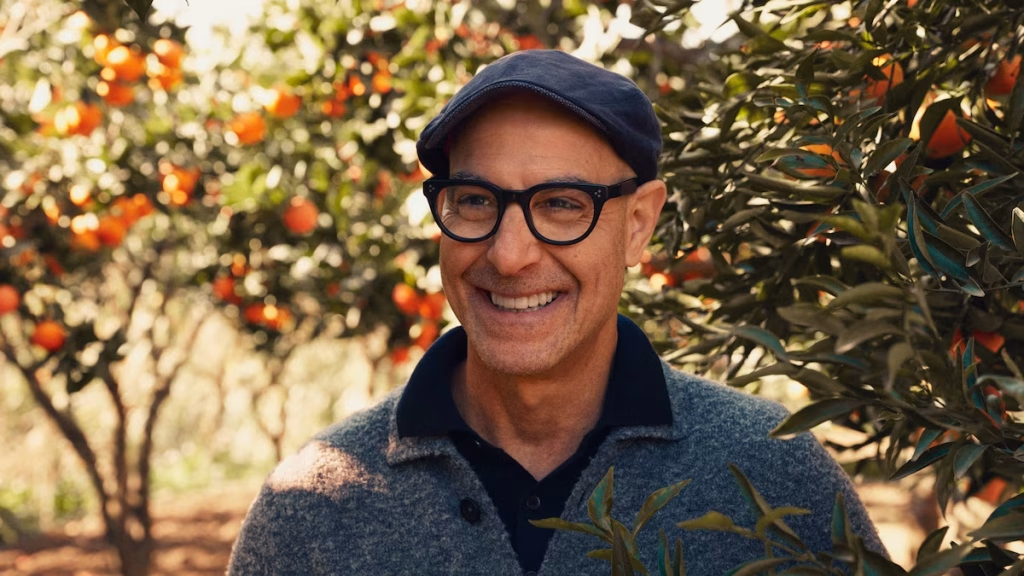
At one point in the episode, Tucci visits a blood orange orchard near Mount Etna. He describes it as “a garden of Eden, an oasis,” and the camera makes it easy to see why. What follows is about as Sicilian a conclusion as you can reach: the oranges sliced with wild fennel, some olive oil, salt, bread, a glass of wine.
“It’s the simplest dish in the world,” he told National Geographic. “Olive oil, salt: eat it. Have a glass of wine, some bread. You’ll live forever.”
There’s a particular truth to that kind of simplicity in Sicilian food. The ingredient carries the weight. The work has already been done by the farmer, the soil, the cold nights and the volcanic ground underneath. By the time the orange reaches your table, everything that makes it extraordinary is already inside it.
Why it matters where Sicilian blood oranges come from
We’ve written about this before on SFC, but it’s worth revisiting here because the where is genuinely inseparable from the what.
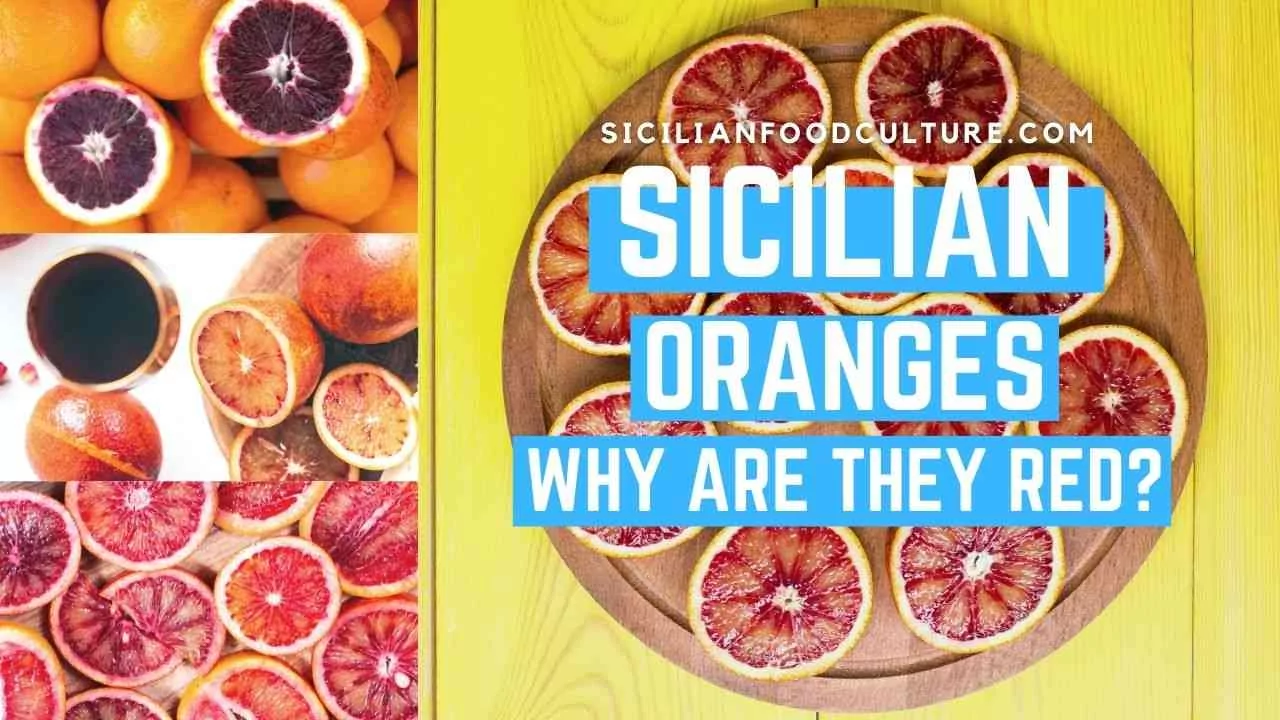
The red colour in Sicilian blood oranges comes from anthocyanins, pigments that develop in response to cold temperatures at night. Citrus grown in consistently warm climates simply doesn’t produce them in the same way. It’s the dramatic temperature swing in the Etna zone, warm and dry during the day, cold after sunset, that triggers the accumulation of these pigments in the pulp and, in some varieties, the skin itself.
This is why an “arancia rossa” from somewhere else is not really the same thing. The IGP designation for the Arancia Rossa di Sicilia covers three varieties, all grown in the provinces of Catania, Enna, Ragusa and Siracusa.
Tarocco is the most widely cultivated and arguably the sweetest. Orange skin with red blushes, deeply pigmented flesh, virtually no seeds. It originated in the Syracuse territory and has the highest vitamin C content of the three varieties.
Moro comes from the Lentini area and is the most intensely pigmented of all: the pulp can reach a deep burgundy, almost purple-red, with a flavour that nudges toward raspberry. The name is not subtle. Moro means dark.
Sanguinello is more restrained in its sweetness, with a thinner skin and a pulp streaked with red rather than saturated by it. There’s a specific variety from Catania, the Sanguinello Moscato, whose aroma is distinctly reminiscent of grape.
Each variety peaks at a slightly different point in the season, which runs from December through to May. Tucci’s orchard visit, filmed sometime earlier this year, would have caught the fruit close to the end of its run.
“I’m not Italian. I’m Sicilian.”
One of the more striking moments in National Geographic’s interview with Tucci is when he observes that Sicilians “will still say, no, I’m not Italian. I’m Sicilian. So that sort of says it all right there.”
It’s something anyone in this community will recognise, whether you grew up in the US, the UK, Australia or Canada, carrying a Sicilian identity that felt genuinely distinct from a broader Italian one. The blood orange is part of that distinctiveness in a very concrete way. It doesn’t grow just anywhere. It grows there, in that particular soil, under that sky, on the slopes of that volcano. The geography is not incidental; it’s the whole point.
Tucci’s episode seems to understand this. It doesn’t try to flatten Sicily into something easier to explain. It lets the island be what it is: layered, proud, shaped by a dozen different histories, and extraordinarily good to eat.
How to use blood oranges in your kitchen
Tucci’s salad with wild fennel is the obvious place to start, and it really is as good as it sounds. If you can find fresh wild fennel, use it. The fronds of a regular fennel bulb will get you a good part of the way there if you can’t.
Beyond the salad, blood orange juice works beautifully in a granita (juice, water, sugar, patience, nothing else), in a vinaigrette over bitter greens like radicchio or endive, as a marinade for grilled fish or pork, or simply squeezed over vanilla gelato.
The season runs through May, so if you’re in the northern hemisphere you’re in the final stretch. A good Italian deli or specialist grocer should still have them. After that, December.

Authentic Sicilian ingredients, delivered to your door
Shop Bronte pistachios, artisan pasta, extra virgin olive oil and more on Dolceterra.com — use code SICILIANFOODCULTURE10 for 10% off your order.
If you enjoyed this article, consider supporting us with a small donation — it helps keep the site running!
 Buy us a Cannolo!