Every year, on 19 March, in many countries in southern Italy, bread becomes a symbol, an offering, a ritual gesture. It is the day dedicated to St Joseph, patron saint of orphans, the poor and carpenters.
During this celebration, he becomes the protagonist of a festival that intertwines Christian faith with ancient rites linked to the earth and its renewal, in the moment before the beginning of spring.
The popular origins of this celebration are very ancient and date back to at least the 15th century. Its roots are connected to the agrarian cults of fertility, practised in honour of Demeter, goddess of agriculture and harvests, to whom tradition also attributes the birth of bread.
It is not surprising that in almost all countries of the eastern Mediterranean, bread has remained the symbolic centrepiece of the festival. It represents the most important food, becoming both the sacred and profane protagonist of this symbolic celebration.
In fact, the central ritual around which the festival is organised is still today the preparation of St Joseph’s bread, made to commemorate Jesus’ Last Supper with the apostles. In this context, bread takes on both a sacred and profane value in a celebration full of meaning.
The feast is therefore not only a Christian calendar event, but in southern Italy it has become an authentic collective ritual, in which elements of pagan origin survive strongly.
Between bonfires lighting up the squares, festively laid tables and gestures passed down through generations, the community comes together in a blend of devotion, tradition and celebration.
One of the most fascinating aspects of this ritual is the presence of numerous local variations. While maintaining the profound meanings of devotion intact, its outward forms change from one area to another, giving shape to different ritual, attributable to the traditions of each community.
In Sicily, one of the most symbolic and evocative moments of this festival is the evening before, when according to an ancient tradition, people light bonfires called “vampe”, dedicated to Saint Joseph. These are large bonfires, fuelled by wood, furniture that is not always disused and, more rarely, by objects. Furthermore, especially in some Sicilian areas, such as the town of Scicli and occasionally in Palermo, there is a custom of placing straw puppets and rags on top of the bonfires to be set on fire together with the wood, in order to further strengthen the symbolic value of the ritual.
Fire thus becomes an element of offering and purification, recalling the archaic use of the “catasta”,
intended as a veritable altar on which to consume, through combustion, many devotional gifts such as bread or coins are consumed through combustion. The atmosphere of free and festive participation that characterizes the event, making behavior more spontaneous, also helps to reinforce its meaning. This transforms the ritual into a moment of collective expression and identity.
After the eve, 19 March is dedicated to setting up the tables of St. Joseph. These are altars prepared with great care by believers, often decorated with lace and images of the saint, laid with bread, wine and citrus fruits, especially oranges. Next to the altars, tables are set with food, offered as a sign of devotion and thanksgiving. According to tradition, the tables are set up either in the main squares or in the homes of the believers, left open to give everyone the opportunity to access them and taste the dishes prepared in honour of the saint.
This ritual is one of the most significant expressions of popular culture in Puglia, particularly in southern Salento, and above all in Sicily, where the cult of St Joseph takes many different and complex forms. Among these, the best known and most characteristic event takes place in the town of Salemi, where on Saint Joseph’s Day about sixty tables are set up, around which the faithful gather to eat together and share moments of prayer.
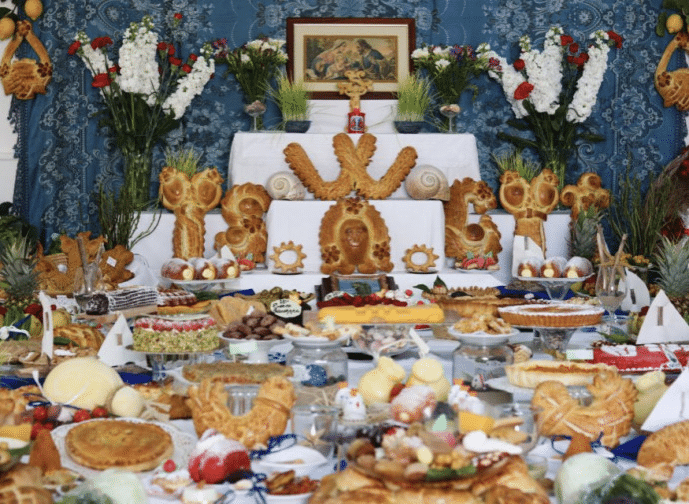
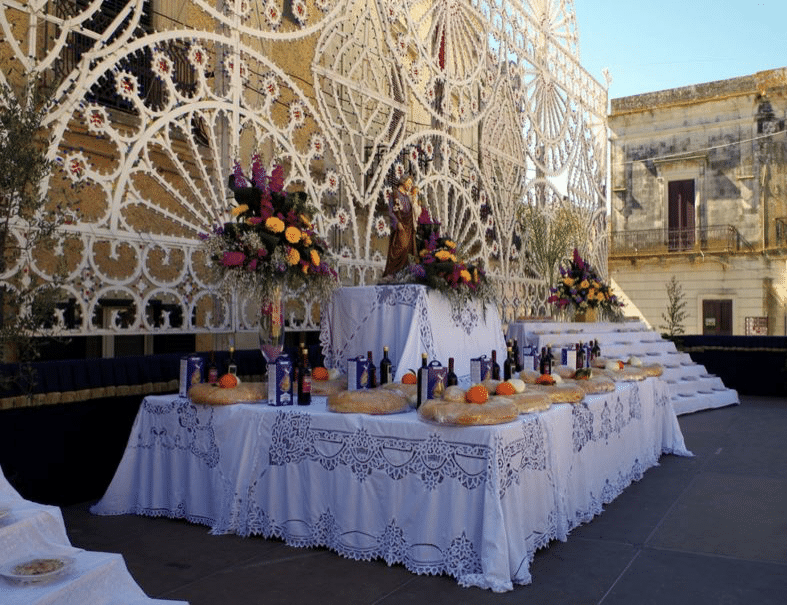
The tables are laid with around a hundred dishes, which vary depending on the region. The most commonly used ingredients are local, simple and unprocessed: fruit such as grapes, prickly pears, oranges and mandarins; vegetables such as wild fennel, wild asparagus and chard (giri); eggs and flour. In Sicily, some of the most typical dishes include “masse”, short pasta cooked with chickpeas or honey, fried fish called “ope”, and asparagus and fennel omelettes.
Beyond Saint Joseph’s Bread, the feast continues at the table.
Discover our traditional recipes for:
– Pasta con le Sarde
– Sfinge di San Giuseppe
– Cuddura
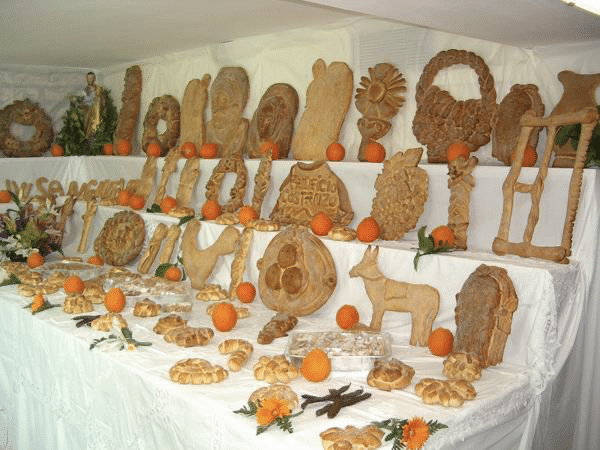
However, the central role is played by votive bread, called “Pupo ri San Giuseppi” or “cuddura” in Sicilian dialect. Prepared mainly by women several days before the feast, this bread takes various forms, such as animals, plants and humans. Most often featuring symbolic references to sacredness, the most famous and frequent are the breads placed at the centre of the altar, which reproduce parts of the saint’s body such as the hand, face or Holy Family. In particular, each one identifies a specific and different saint, such as St Joseph, in the shape of a stick, decorated with a carpenter’s tools, a dove, and a bunch of grapes. Another typical custom is the preparation of ring-shaped breads, enriched with sacred symbols such as olive leaves.
In addition to the strong symbolic value of bread, a symbol of solidarity and togetherness, the festival is also characterised by the consumption of traditional sweets, whose preparation varies depending on the geographical area.
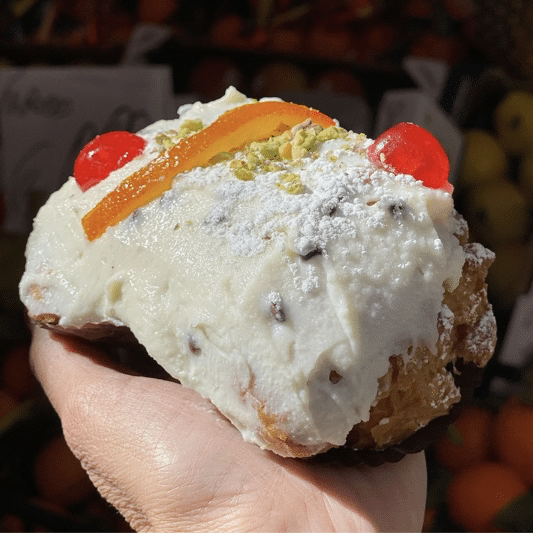
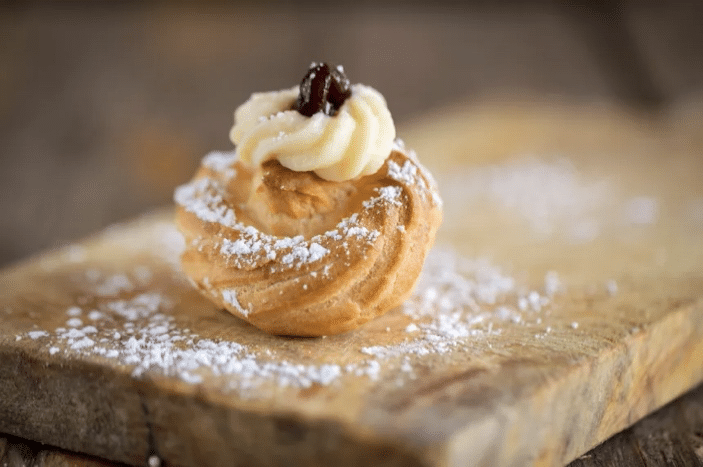
Among the most popular are “sfinci”, sweets made with sweetened ricotta cheese and candied fruit, and “zeppole”, fried or baked, made with flour, eggs and butter. In Sicily, in particular, zeppole are usually fried, covered with honey, icing sugar and cinnamon, or filled with pistachio or ricotta cheese, as is the case in the Syracuse area.
What happens during the celebration of St Joseph teaches us that feasts are much more than simple anniversaries: they are complex phenomena in which tradition, food and rituals become instruments of relationship and belonging. Through bread, tables and the sharing of meals, on 19 March, each community tells its own story, its connection with the land and with the sacred. It is no coincidence that anthropologist Marcel Mauss defined these events as “total social facts”, capable of involving the entire social life of a people.

Authentic Sicilian ingredients, delivered to your door
Shop Bronte pistachios, artisan pasta, extra virgin olive oil and more on Dolceterra.com — use code SICILIANFOODCULTURE10 for 10% off your order.
If you enjoyed this article, consider supporting us with a small donation — it helps keep the site running!
 Buy us a Cannolo!